
ATPL(H) Theory.
Structured for
rotorcraft ambitions.
One EASA ATPL(H) programme. Two professional pathways: VFR or IR. The same €4,999 course fee — with the freedom to choose the route that fits your helicopter career.
Built for pilots who operate beyond the ordinary.
Helicopter aviation is different. Offshore transport, HEMS, corporate operations and complex commercial missions demand disciplined decision-making and deep technical knowledge. Cranfield's ATPL(H) programme combines flexible digital learning with personal instructor support and a training structure designed for professional rotorcraft pilots worldwide.
Choose the ATPL-H/IR or ATPL-H/VFR pathway and complete your theoretical training with an EASA-approved organisation that understands international careers.
One course. Two ways to shape your helicopter career.
Both pathways are offered at the same course fee of €4,999. The right choice depends on where you want your helicopter career to take you — and whether you want to preserve the option of adding an Instrument Rating.
Focused on professional VFR operations.
A clear route for pilots whose planned professional helicopter operations do not require an IR(H). You complete the ATPL(H) theoretical knowledge pathway while keeping the training focused on your VFR career objective.
Keep the IFR door open.
For pilots considering IFR-oriented helicopter operations, the ATPL(H)/IR pathway preserves an important option. After your final theoretical examination pass, the relevant theoretical knowledge remains valid for the issue of an IR for 36 months under Part-FCL.
VFR today. IFR when your career demands it.
You do not need to complete the practical Instrument Rating immediately. By choosing the ATPL(H)/IR theoretical pathway, you create a defined period after your final examination pass in which you can complete the practical IR(H) training without repeating the relevant theoretical knowledge examinations, subject to the applicable Part-FCL requirements.
If you do not obtain the IR(H) within that 36-month validity period, you can continue on the ATPL(H) VFR pathway; the unused IR theoretical validity does not turn your professional helicopter training into a dead end.
Course flow.
The ATPL(H) course is organised in three stages. Each stage combines structured self-study with our digital learning environment, progress testing, school examinations and live brush-up. You then complete the official EASA theory examinations under the applicable EASA examination framework.
Three stages. Thirteen subjects. One professional standard.
Everything you need to succeed.
Online study material
Structured web-based training and comprehensive study guides.
Video lessons
Digital explanations for key topics throughout the syllabus.
3 weeks brush-up
Live instruction and direct access to experienced instructors.
Personal support
Guidance throughout self-study and examination preparation.
EASA question training
Exam-focused preparation with our integrated question bank.
Progress tests
Track your knowledge and readiness throughout the course.
One platform. Everything you need to stay ahead.
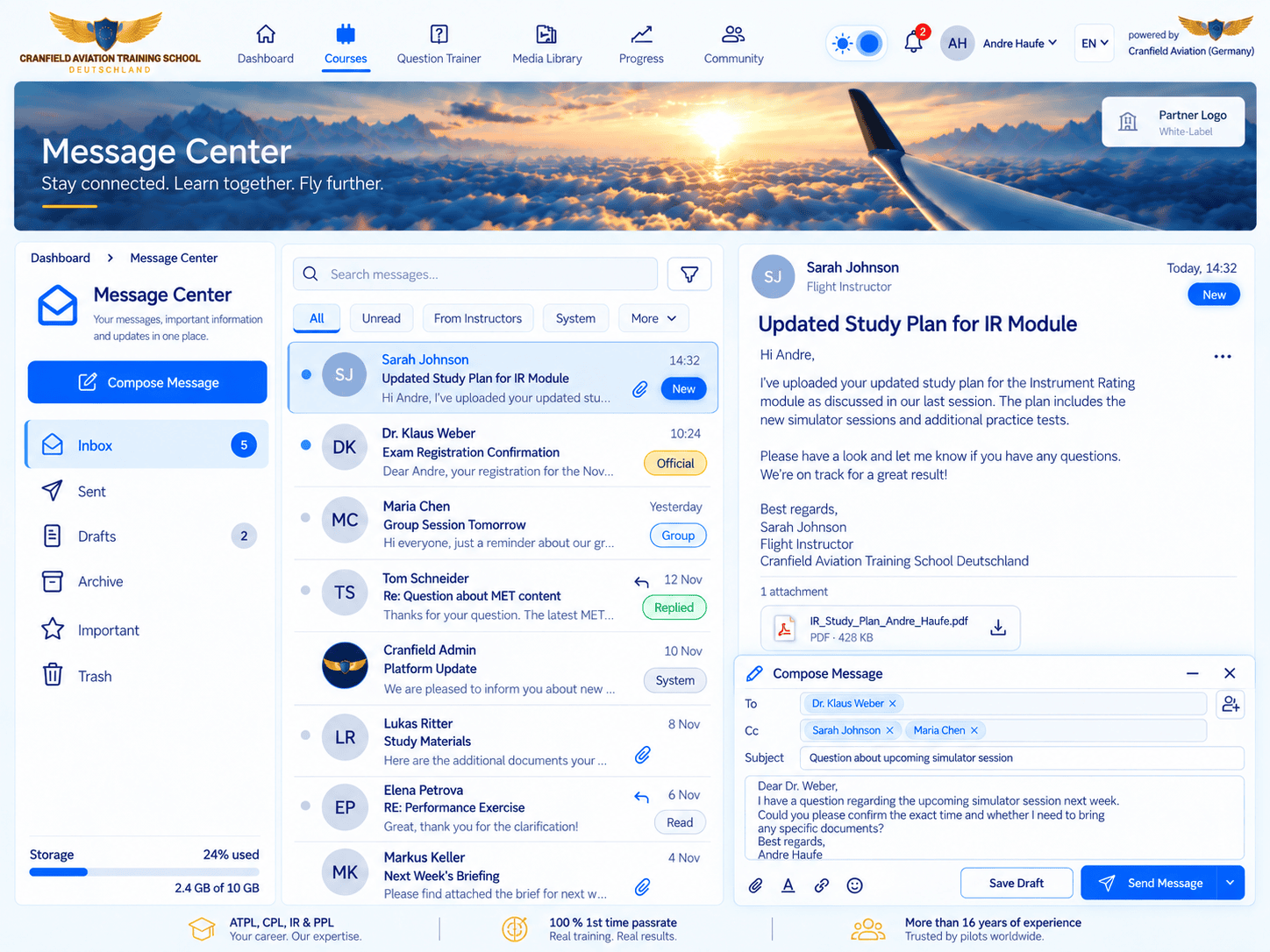
Study guides, video lessons, progress tracking, school exams and question-bank training come together in the Cranfield learning environment.
Your questions, answered.
What is the difference between ATPL(H)/IR and ATPL(H) VFR?
Why would I choose ATPL(H)/IR if the price is the same?
How long does the course take?
Can I study while working or flying professionally?
Where can I take my EASA exams?
Can I complete practical training with another ATO?
Real students. Real results.
Google reviews
Ready for your next mission?
Join the Cranfield community and start your EASA ATPL(H) theory journey.